
Soil Mechanics and Foundation Sheet 20
-
1) Question.
In case of coarse grained sand having high permeability and low plasticity, 95% of consolidation occurs within...... after application of load.
Answer. -
2) Question.
The time factor corresponding to 25% degree of consolidation is given by
Answer. -
3) Question.
The relation between coefficient of consolidation (), time factor , drainage path (d) and time (t) is given by
Answer. -
4) Question.
The ratio of settlement at any time (t) to the final settlement is known as
Answer. -
5) Question.
The relation between coefficient of consolidation , coefficient of volume change and coefficient of permeability (k) is given by
Answer. -
6) Question.
The time factor for a clay layer is
Answer. -
7) Question.
The degree of consolidation is proportional directly
Answer. -
8) Question.
The rate of consolidation...... with the increase in temperature.
Answer. -
9) Question.
The coefficient of consolidation is used for evaluating
Answer. -
10) Question.
The decrease in voids ratio per unit increase of pressure is called
Answer. -
11) Question.
As per converse Labarre formula, group efficiency of friction piles is given by:
where
m = number of columns
n = number of rows
d = diameter of pile
s = c/c spacing of pile
Answer. -
12) Question.
In care of free over damped vibration,
Answer. -
13) Question.
The natural frequency of a vibrating foundation system
i) increases as the square root of the spring stiffness
ii) decreases with the square root of the spring stiffiness
iii) increases as the square root of the mass of the body
iv) decreases with the square root of the mass of the body
of these statements:
Answer. -
14) Question.
The soils most susceptible to liquefaction are
Answer. -
15) Question.
The unit weight of a soil at zero air voids depends on:
Answer. -
16) Question.
A soil having particles of nearly the same size is known as:
Answer. -
17) Question.
Select the incorrect statement
Answer. -
18) Question.
In the plate loading test for determining the bearing capacity of soil, the size of square bearing plate should be
Answer. -
19) Question.
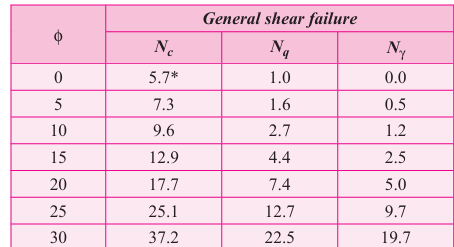
Terzaghi's bearing capacity factors Nc, Nq and Ny are functions of
Answer. -
20) Question.
Terzaghi's general bearing capacity formula for a strip footing
C NC+y D Nq+0.5 y NyB gives
where C = unit cohesion
y = unit weight of soil
D = depth of foundation
B = width of foundation
Nc, </m
Answer.