
Soil Mechanics and Foundation Sheet 21
-
1) Question.
According to Coulomb's law, the shearing strength of soil is
[c= Cohesion (apparent or actual), p= Normal stress on the plane of shear, = Angle of internal friction or angle of shearing resistance]
Answer. -
2) Question.
The angle of shearing resistance for dry loose sand is same as that of angle of internal friction.
Answer. -
3) Question.
The angle of internal friction of round-grained dense sand is about
Answer. -
4) Question.
The angle of internal friction of round-grained loose sand is about
Answer. -
5) Question.
Which one of the following parameters can be used to estimate the angle of friction of a sandy soil ?
Answer. -
6) Question.
The settlement of a footing in clays is given by
Answer. -
7) Question.
If the pressure on a clay layer increases slightly from p to p+p and the void ratio decreases from to e, then the coefficient of compressibility is given by
Answer. -
8) Question.
The unit of coefficient of compressibility is inverse of pressure.
Answer. -
9) Question.
The coefficient of compressibility..... with increase in pressure.
Answer. -
10) Question.
The coefficient of volume of compressibility is given by
[= Coefficient of compressibility, = Void ratio]
Answer. -
11) Question.
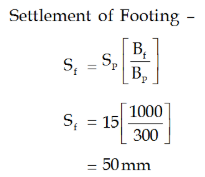
A 300 mm square bearing plate settles by 15 mm in a plate load test on a cohesive soil when the intensity of loading is 0.2 N/mm2. The settlement of a prototype shallow footing 1 m square under the same intensity of loading is
Answer. -
12) Question.
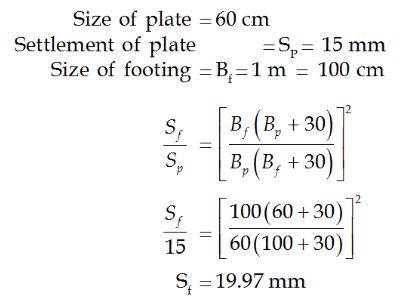
A 600 mm square bearing plate settles by 15 mm in plate load test on cohesionless soil under an intensity of loading of 0.2 N/mm2. The settlement of a prototype shallow footing 1 m square under the same intensity of loading is
Answer. -
13) Question.
The rise of water table below the foundation influences the bearing capacity of soil mainly by reducing
Answer. -
14) Question.
The net ultimate bearing capacity of a purely cohesive soil
Answer. -
15) Question.
According to Terzaghi's theory, the ultimate bearing capacity at ground surface for a purely cohesive soil and for a smooth base of a strip footing is
where C = unit cohesion of soil
Answer. -
16) Question.
Base failure of a finite slope
Answer. -
17) Question.
A cylindrical specimen of saturated soil failed under an axial vertical stress of when it was laterally unconfined. The failure plane was inclined to the horizontal plane at an angle of . The values of cohesion and angle of internal friction for the soil are respectively
Answer. -
18) Question.
In a deposit of normally consolidated clay
Answer. -
19) Question.
Shear strength of a soil is a unique function of
Answer. -
20) Question.
Skempton's pore pressure coefficient B for saturated soil is
Answer.